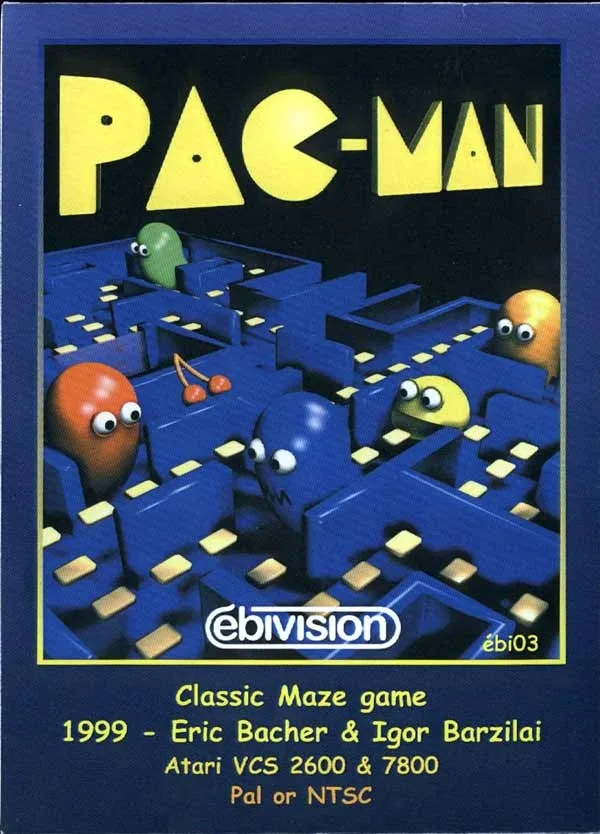
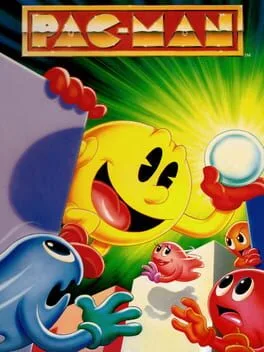
Pac-Man (Ebivision)
Atari 2600 · 1999
About this game
Pac-Man is a single-player maze game.
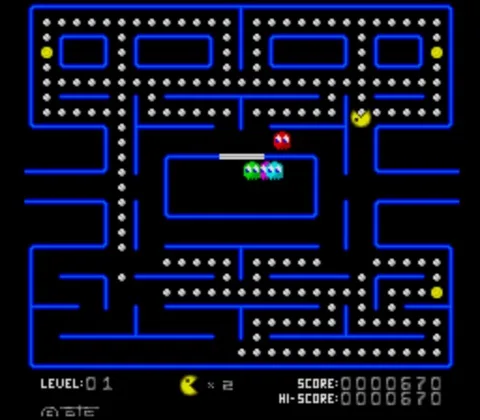
The player controls Pac-Man, a yellow, circular character who must navigate a series of enclosed mazes while eating small pellets scattered along the paths.
↓ Read more
The objective in each stage is to clear the maze of all pellets while avoiding capture by four ghosts who pursue Pac-Man relentlessly.
As the player progresses, the mazes repeat but with increased difficulty as the ghosts become faster and more aggressive.
The ghosts each follow distinct behavioral patterns that affect how they chase the player.
Blinky, the red ghost, targets Pac-Man directly.
Pinky, the pink ghost, attempts to ambush from ahead.
Inky, the blue ghost, uses a conditional strategy that can create unpredictable movement, while Clyde, the orange ghost, alternates between chasing and wandering aimlessly.
One touch from any ghost results in the loss of a life, and the game ends when all lives are lost.
To counter the ghosts, four large power pellets, known as Energizers, are positioned in the corners of the maze.
Eating one temporarily changes the ghosts to a vulnerable blue state, allowing Pac-Man to chase and consume them for bonus points.
When eaten, the ghosts’ eyes return to the central box where they regenerate and resume pursuit.
Fruits and other bonus items also appear occasionally in the maze, granting additional points if collected.
The game offers continuous play with no fixed ending.
After every few stages, short comedic intermissions between Pac-Man and the ghosts are shown as lighthearted rewards, becoming progressively more elaborate.
As players advance through more levels, the speed of the game increases and the Energizer effect shortens, eventually reaching a point where the ghosts no longer turn blue.
Pac-Man was first released in arcades and has since been reissued under multiple titles, including Jelly Monsters , PacMan , Arcade Archives: Pac-Man , and Arcade Game Series: Pac-Man (amongst others).
These versions preserve the original gameplay,
About Atari 2600
The Atari 2600 (1977) was the console that first proved interchangeable game cartridges could sustain a mass-market business, effectively founding the home console industry as we know it. Most common 2600 titles are inexpensive today given how many units and copies were sold, but a small number of extremely rare releases — including several from Atari's own late-era prototype and licensed titles — are among the most valuable cartridges in retro collecting.
Gamevaro tracks Pac-Man (Ebivision) for Atari 2600 with separate market values for loose, complete-in-box (CIB) and factory-sealed copies, sourced from real eBay sales. Prices also vary by region — PAL, NTSC-U and NTSC-J releases of the same game often sell for different amounts due to print run sizes and regional collector demand.
Adding Pac-Man (Ebivision) to a Gamevaro collection takes seconds — search by title or scan the box barcode, and the app fills in cover art, release details and current pricing automatically. This A2600 release dates back to 1999.
Market values by condition
No price data available yet.
Rarity & condition
No market sales have been tracked yet for Pac-Man (Ebivision) — this could mean it rarely changes hands, or simply that Gamevaro hasn't recorded a sale for it yet. Be the first to add it to your collection.
Complete-in-box (CIB) copies typically command a premium over loose cartridges/discs because the original box and manual are more fragile and get discarded or damaged over time — fewer complete sets survive.
Frequently asked questions
How much is Pac-Man (Ebivision) worth?
Gamevaro hasn't tracked a market sale for Pac-Man (Ebivision) (Atari 2600) yet, so no current value is available. Prices are sourced from real marketplace sales, and this page will update automatically once sales data comes in.
Is Pac-Man (Ebivision) rare?
No market sales have been tracked yet for Pac-Man (Ebivision), which could mean it rarely changes hands or that Gamevaro simply hasn't recorded a sale for it yet.
What's the difference between loose, CIB and sealed for Pac-Man (Ebivision)?
Loose means cartridge or disc only, CIB (complete in box) includes the original box and manual, and sealed means factory-sealed and never opened. These are tracked as separate market values because the price gap between them can be significant, especially for older releases.
Ratings & Reviews
Also on other platforms
![Pac-Man [10th Anniversary]](/covers/nes/89103.webp)
![Pac-Man [Tengen]](/covers/nes/86777.webp)
![Pac-Man [Tengen Gray]](/covers/nes/173511.webp)
![Pac-Man [Player's Choice]](/covers/game-boy/163145.webp)
![Pac-Man [Namco]](/covers/nes/87850.webp)
![Pac-Man [Classic NES Series]](/covers/game-boy-advance/163619.webp)

