Sinistar
Atari 5200 · 1983
About this game
The player pilots a lone spacecraft, and must create "Sinibombs" by shooting at drifting planetoids and catching the crystals that are thereby released.
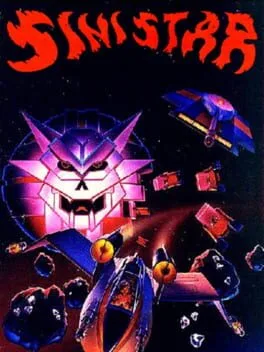
Sinibombs are needed to defeat the game boss, Sinistar, an animated spacecraft with a demonic skull face.
↓ Read more
Sinistar does not exist at the start of the game, and is continuously under construction by enemy worker ships.
Though time is crucial, attempting to mine too quickly will destroy a planetoid without releasing any crystals.
Enemy worker ships are also gathering crystals (often stealing them from the player) which they use to construct the Sinistar.
Enemy warrior ships can directly attack the player's ship.
The player is given a head-start before the enemy ships have enough crystals to begin construction.
Game ends when the player's ships are all destroyed.
Once the Sinistar is completely formed, a digitized voice makes various threatening pronouncements, including "Beware, I live!," "I hunger, coward!," "I am Sinistar!," "Run! Run! Run!," "Beware, coward!", "I hunger!," "Run, coward!," and a loud roaring sound.
The Sinistar has no weapon attacks, but if it contacts the player's ship while it darts about the playfield, the player's ship will be "eaten" and destroyed.
A total of 13 Sinibombs are required to destroy a fully built Sinistar, although an incomplete Sinistar can be damaged to slow construction.
Each short-range Sinibomb automatically targets the Sinistar when fired, but can be intercepted by a collision with an enemy ship, enemy fire, or a planetoid.
The player moves from one zone to the next each time he defeats the Sinistar.
A sequence of four zones repeats continuously after the first zone.
Each is named for the most numerous feature of that zone: Worker Zone, Warrior Zone, Planetoid Zone, and Void Zone (the Void Zone is especially difficult because it has very few planetoids).
Beginning with the first Worker Zone, a completed but damaged Sinistar can be repaired/rebuilt by the enemy ships by gathering more crystals, extending its "lifespan" if the player is unable to kill it quickly.
About Atari 5200
The Atari 5200 (1982) was Atari's attempt to modernize the 2600 formula with better graphics and an analog joystick, but it launched just before the North American video game market crash of 1983 and never recovered commercially. Its short, crash-era lifespan means a comparatively small library, making the 5200 a niche but accessible corner of early-console collecting.
Gamevaro tracks Sinistar for Atari 5200 with separate market values for loose, complete-in-box (CIB) and factory-sealed copies, sourced from real eBay sales. Prices also vary by region — PAL, NTSC-U and NTSC-J releases of the same game often sell for different amounts due to print run sizes and regional collector demand.
Adding Sinistar to a Gamevaro collection takes seconds — search by title or scan the box barcode, and the app fills in cover art, release details and current pricing automatically. This A5200 release dates back to 1983.
Market values by condition
No price data available yet.
Rarity & condition
No market sales have been tracked yet for Sinistar — this could mean it rarely changes hands, or simply that Gamevaro hasn't recorded a sale for it yet. Be the first to add it to your collection.
Complete-in-box (CIB) copies typically command a premium over loose cartridges/discs because the original box and manual are more fragile and get discarded or damaged over time — fewer complete sets survive.
Frequently asked questions
How much is Sinistar worth?
Gamevaro hasn't tracked a market sale for Sinistar (Atari 5200) yet, so no current value is available. Prices are sourced from real marketplace sales, and this page will update automatically once sales data comes in.
Is Sinistar rare?
No market sales have been tracked yet for Sinistar, which could mean it rarely changes hands or that Gamevaro simply hasn't recorded a sale for it yet.
What's the difference between loose, CIB and sealed for Sinistar?
Loose means cartridge or disc only, CIB (complete in box) includes the original box and manual, and sealed means factory-sealed and never opened. These are tracked as separate market values because the price gap between them can be significant, especially for older releases.