Strider
Commodore 64 · 1989
About this game
The controls of Strider consist of an eight-way joystick and two action buttons for attacking and jumping.
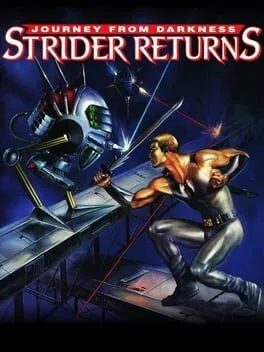
The player controls Hiryu himself, whose main weapon is a tonfa-like plasma sword known as "Cypher".
↓ Read more
He can perform numerous acrobatic feats depending on the joystick/button combination used.
Pressing the jump button while Hiryu is standing still will cause him to do a regular vertical jump, while pressing the jump button while pushing the joystick left or right will enable him to do a cartwheel jump.
Hiryu can also slide under or through certain obstacles and enemies by first crouching down and then pressing the jump button.
As well as his sliding move, both jumps can also be used to destroy weaker opponents.
Hiryu is able to latch onto certain platforms, and climb across walls and ceilings using a metallic hook.
While running down a sloped surface, Hiryu can gain enough momentum to allow him to do a longer cartwheel jump than usual.
Numerous power-ups can be obtained from item boxes carried by certain enemies.
These includes an extension to Hiryu's attack range that lasts for one hundred slashes, two types of health aids (represented by the kanji used to write Hiryu's name: 飛 and 飛竜), a max health extension (represented by the kanji 竜, the second character in Hiryu's name), an extra life, and a power-up that not only makes Hiryu invulnerable to attack but also increases his own attack abilities via shadow images of himself for 15 seconds.[3] Hiryu can also summon robotic companions known collectively as "options" that help him fight enemies.
These consist of up to two mushroom-like droids, a saber-toothed tiger and a hawk, known individually as Option A, B and C respectively.
The game has five stages: the Kazakh Soviet Socialist Republic (called "St.
Petersburg" during the arcade game's attract sequence), the Siberian Wilderness, the Aerial Battleship Balrog (געלראב), the Amazonian Jungle, and the Grandmaster's lair itself, the Third Moon.
Each of the stages is divided into a number of smaller sections, each with their own time limit and checkpoint location.
The player has a three-point health gauge (which can be increased to five points with the health extensions.
Hiryu will lose a life when either his health gauge is fully depleted, by moving him off the screen entirely (like falling into a bottomless pit) or when the game's timer reaches zero.
It's Game Over when all of Hiryu's lives are lost, but the player can be given the opportunity to continue.
About Commodore 64
Released in 1982, the Commodore 64 is the best-selling home computer model of all time, with an enormous software library spanning games, productivity tools, and everything in between. C64 game collecting centers on cassette tapes and floppy disks in their original packaging — physical media that's inherently fragile, so complete, working copies from the era are increasingly prized by retro computing collectors.
Gamevaro tracks Strider for Commodore 64 with separate market values for loose, complete-in-box (CIB) and factory-sealed copies, sourced from real eBay sales. Prices also vary by region — PAL, NTSC-U and NTSC-J releases of the same game often sell for different amounts due to print run sizes and regional collector demand.
Adding Strider to a Gamevaro collection takes seconds — search by title or scan the box barcode, and the app fills in cover art, release details and current pricing automatically. This C64 release dates back to 1989.
Market values by condition
PAL
Recent sales
| Date | Type | Region | Price |
|---|---|---|---|
| 2026-07-20 | Loose / Item only | PAL | €19.99 |
Rarity & condition
Only a handful of market sales have been tracked for Strider, suggesting it doesn't trade hands very often — a sign of relative scarcity compared to more common Commodore 64 titles.
Complete-in-box (CIB) copies typically command a premium over loose cartridges/discs because the original box and manual are more fragile and get discarded or damaged over time — fewer complete sets survive.
Frequently asked questions
How much is Strider worth?
Strider for Commodore 64 is currently worth €19.99 loose. Prices are based on real sales and update regularly on Gamevaro.
Is Strider rare?
Strider has only a handful of tracked market sales, suggesting relative scarcity compared to more common Commodore 64 titles.
What's the difference between loose, CIB and sealed for Strider?
Loose means cartridge or disc only, CIB (complete in box) includes the original box and manual, and sealed means factory-sealed and never opened. These are tracked as separate market values because the price gap between them can be significant, especially for older releases.
Ratings & Reviews
Also on other platforms


More Commodore 64 games