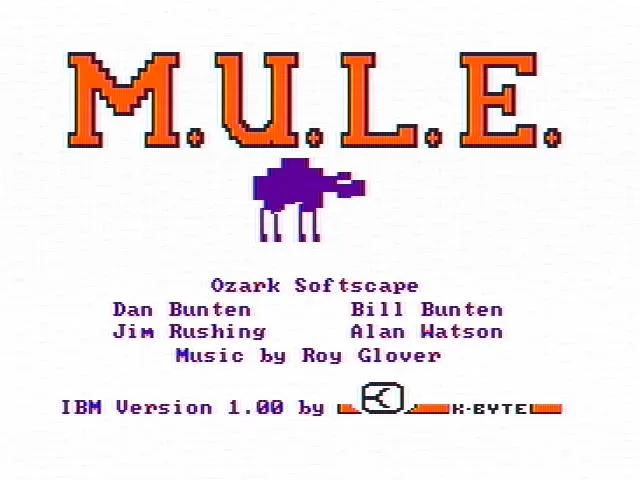
M.U.L.E.
Commodore Amiga · 1982
About this game
M.U.L.E. is about four hopeful explorers trying to make a fortune on a virgin planet.
This is done by producing various goods (Food, Energy, Smithore, Crystite).
↓ Read more
Each of these goods have their uses: if you don't have enough food, you will have less time during your turn.
If you don't have enough energy, your output will be lower.
If enough smithore isn't produced, there will be a shortage of M.U.L.E.s.
Crystite is the big earner that can make or break your game.
You start the game by selecting your race.
Some are easier to play, some harder.
There are three levels of difficulty, in the easiest the game only lasts 6 turns, but the real game is 12 turns.
Crystite is not available at the easiest level.
Each turn starts with a land claim.
Each player gets to choose a spot of land for themselves from the map.
If two players choose the same spot, the player with less money wins.
The map consists of different landscapes.
River is best for producing food, plains for energy, mountains for smithore.
Crystite is hidden and must be first found by taking a land sample to the town.
After the land claim, each player takes turns in cultivating their land and doing other tasks.
They can buy M.U.L.E.s to start production on their land, sabotage other players by buying M.U.L.E.s and letting them loose, try to catch the Wumpus for cash and try to find crystite veins.
The time to do these things depends on if the player has enough food.
Finally the player goes to the casino and wins a small amount of money, depending on how much time was left.
After the cultivation phase is the production phase where each land produces an amount of goods depending on a number of factors such as if the player has enough energy in storage, what type of land is used, and some random events such as sunspots that increase energy output.
Also, if the same player has plots producing the same goods next to each other, they gain a bonus.
Three plots of the same production type anywhere on the map by the same pla
About Commodore Amiga
The Commodore Amiga (1985) was ahead of its time technically — multitasking, custom graphics and sound chips — and built a passionate following in Europe in particular, where it rivaled and often outsold contemporary consoles. Amiga collecting today is a niche but dedicated hobby: original boxed software on floppy disk is comparatively scarce since floppies degrade, making well-preserved complete copies genuinely valuable to the right collector.
Gamevaro tracks M.U.L.E. for Commodore Amiga with separate market values for loose, complete-in-box (CIB) and factory-sealed copies, sourced from real eBay sales. Prices also vary by region — PAL, NTSC-U and NTSC-J releases of the same game often sell for different amounts due to print run sizes and regional collector demand.
Adding M.U.L.E. to a Gamevaro collection takes seconds — search by title or scan the box barcode, and the app fills in cover art, release details and current pricing automatically. This AMIGA release dates back to 1982.
Market values by condition
No price data available yet.
Rarity & condition
No market sales have been tracked yet for M.U.L.E. — this could mean it rarely changes hands, or simply that Gamevaro hasn't recorded a sale for it yet. Be the first to add it to your collection.
Complete-in-box (CIB) copies typically command a premium over loose cartridges/discs because the original box and manual are more fragile and get discarded or damaged over time — fewer complete sets survive.
Frequently asked questions
How much is M.U.L.E. worth?
Gamevaro hasn't tracked a market sale for M.U.L.E. (Commodore Amiga) yet, so no current value is available. Prices are sourced from real marketplace sales, and this page will update automatically once sales data comes in.
Is M.U.L.E. rare?
No market sales have been tracked yet for M.U.L.E., which could mean it rarely changes hands or that Gamevaro simply hasn't recorded a sale for it yet.
What's the difference between loose, CIB and sealed for M.U.L.E.?
Loose means cartridge or disc only, CIB (complete in box) includes the original box and manual, and sealed means factory-sealed and never opened. These are tracked as separate market values because the price gap between them can be significant, especially for older releases.