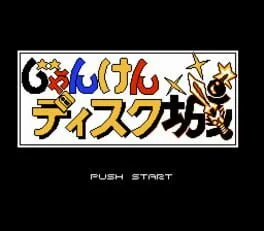
Janken Disk Shiro
Famicom Disk System · 1992
About this game
The sixth and final game featured as the coverdisk of the Japanese Famimaga magazine.
Janken Disk Shiro is a block-pushing puzzle game based on the playground game Janken (Rock, Paper, Scissors).
↓ Read more
Janken Disk Shiro, or Famimaga Disk Vol. 6 Janken Disk Shiro, is a puzzle game in which the protagonist (who looks uncannily like Disk-kun, the mascot of the Famicom Disk System) must brave a labyrinth of puzzles.
In each room there are three variants of hand-shaped blocks between the hero and the exit: each one either making the "scissors" gesture, the "rock" gesture or the "paper" gesture.
Pushing a block adjacent to another of a different type causes whichever was the inferior (e.g. with paper and rock, rock is the inferior) to vanish.
In addition, each block has a "strength" which is signified by its color: green is level 1, yellow is level 2 and red is level 3.
If a green block is pushed next to an inferior red block, the red block will instead become yellow instead of vanishing (and then green with a subsequent superior block, and then will vanish after a third).
Gameplay revolves around finding the right blocks to push together to clear a way to the exit.
Not every block needs to be eliminated: just those that are direct obstacles between the player and the end of the stage.
The game adopts a familiar veneer of the typical 8-bit fantasy RPG: The player starts in a small town in which they can talk to NPCs and purchase power-ups, they can visit the King in his castle to begin their quest and they can visit the dungeons in which the puzzles are found (after receiving permission from the King).
Janken Disk Shiro has the distinction of being the very last game ever produced for the Famicom Disk System.
The peripheral had been effectively retired by the 90s due to advancements in NES cart technology.
About Famicom Disk System
Japan-only, the Famicom Disk System (1986) was Nintendo's floppy-disk-based add-on for the Famicom, hosting several games (including the original Legend of Zelda and Metroid) before they were later ported to cartridge internationally. Because it never released outside Japan and its proprietary floppy disks degrade over time, complete, working Famicom Disk System software is a specialized import-collecting niche.
Gamevaro tracks Janken Disk Shiro for Famicom Disk System with separate market values for loose, complete-in-box (CIB) and factory-sealed copies, sourced from real eBay sales. Prices also vary by region — PAL, NTSC-U and NTSC-J releases of the same game often sell for different amounts due to print run sizes and regional collector demand.
Adding Janken Disk Shiro to a Gamevaro collection takes seconds — search by title or scan the box barcode, and the app fills in cover art, release details and current pricing automatically. This FDS release dates back to 1992.
Market values by condition
No price data available yet.
Rarity & condition
No market sales have been tracked yet for Janken Disk Shiro — this could mean it rarely changes hands, or simply that Gamevaro hasn't recorded a sale for it yet. Be the first to add it to your collection.
Complete-in-box (CIB) copies typically command a premium over loose cartridges/discs because the original box and manual are more fragile and get discarded or damaged over time — fewer complete sets survive.
Frequently asked questions
How much is Janken Disk Shiro worth?
Gamevaro hasn't tracked a market sale for Janken Disk Shiro (Famicom Disk System) yet, so no current value is available. Prices are sourced from real marketplace sales, and this page will update automatically once sales data comes in.
Is Janken Disk Shiro rare?
No market sales have been tracked yet for Janken Disk Shiro, which could mean it rarely changes hands or that Gamevaro simply hasn't recorded a sale for it yet.
What's the difference between loose, CIB and sealed for Janken Disk Shiro?
Loose means cartridge or disc only, CIB (complete in box) includes the original box and manual, and sealed means factory-sealed and never opened. These are tracked as separate market values because the price gap between them can be significant, especially for older releases.