Shin Megami Tensei
Sega Game Gear · 1994
About this game
A young man lives together with his mother in Kichijoji, a district in modern Tokyo.
One day, he has a strange dream: he is being sucked into another dimension, a strange maze-like structure.
↓ Read more
A spirit appears in front of him and asks him his name.
As he proceeds further, he meets a man who is hanging on a cross, another one who is being tormented by a demon, and a mysterious young woman who is bathing in a pool. "Wake up!" - the voice of his mother cuts through the dream.
The young man wakes up and checks his computer.
Suddenly, a message arrives: the world is headed towards destruction.
Only he who can summon demons through a virtual space will be able to prevent a disaster.
Unable to understand what that means, the young man goes outside and finds out a murder has occurred in the nearby park.
The district must be cut off from the rest of the city until the murderer is found.
As the young man acquires a device that allows him to communicate with demons, he begins to realize that his role in the upcoming events may be greater than he thought.
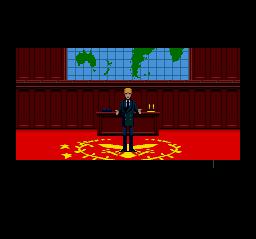
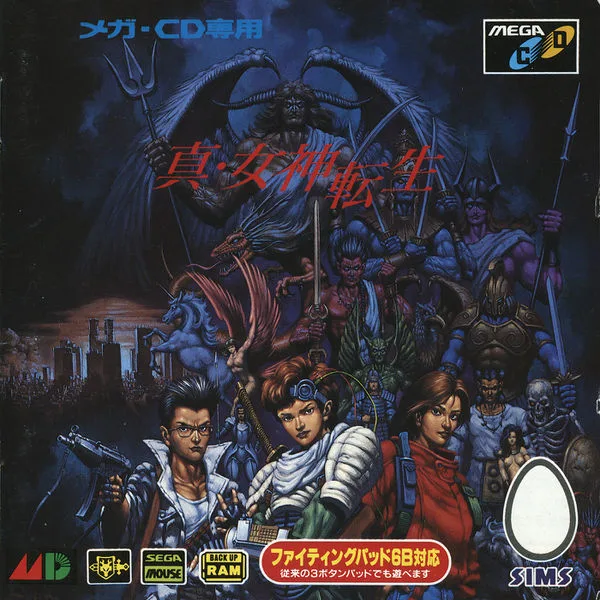
A follow-up to the first two Megami Tensei games, Shin Megami Tensei is a first-person RPG set in modern-day and post-apocalyptic Tokyo.
The hero of the game can summon demons, who consume a mysterious energy called Magnetite, which can be obtained from battles.
The summoned demon joins the party and is then fully controllable by the player.
The active party can include up to six characters: the hero, the heroine, and four slots usually reserved for the demons, though other human characters might also join.
There is a wide variety of demons in the game, most of which are taken from real-world mythologies.
The demons have levels, individual statistics, spells, special abilities, etc.
Enemy encounters are random, and the first-person combat is turn-based.
During combat, human characters can use swords or guns; the heroine is also able to learn and cast magic spells.
Unlike most other Japanese RPGs, the game allows the player to r
About Sega Game Gear
Sega's Game Gear (1990) was a technically capable handheld competitor to the Game Boy, notable for its full-color backlit screen — a real advantage at the time, offset by famously poor battery life. Its commercial underperformance against Nintendo's handheld means smaller print runs overall, and complete, well-preserved cartridges (the plastic shells are prone to yellowing and cracking) are a genuine niche within retro handheld collecting.
Gamevaro tracks Shin Megami Tensei for Sega Game Gear with separate market values for loose, complete-in-box (CIB) and factory-sealed copies, sourced from real eBay sales. Prices also vary by region — PAL, NTSC-U and NTSC-J releases of the same game often sell for different amounts due to print run sizes and regional collector demand.
Adding Shin Megami Tensei to a Gamevaro collection takes seconds — search by title or scan the box barcode, and the app fills in cover art, release details and current pricing automatically. This GG release dates back to 1994.
Market values by condition
No price data available yet.
Rarity & condition
No market sales have been tracked yet for Shin Megami Tensei — this could mean it rarely changes hands, or simply that Gamevaro hasn't recorded a sale for it yet. Be the first to add it to your collection.
Condition matters a lot for collector value: loose (cartridge/disc only), complete-in-box (CIB, with original packaging and manual) and factory-sealed copies are tracked separately because the price gap between them can be significant, especially for older releases.
Frequently asked questions
How much is Shin Megami Tensei worth?
Gamevaro hasn't tracked a market sale for Shin Megami Tensei (Sega Game Gear) yet, so no current value is available. Prices are sourced from real marketplace sales, and this page will update automatically once sales data comes in.
Is Shin Megami Tensei rare?
No market sales have been tracked yet for Shin Megami Tensei, which could mean it rarely changes hands or that Gamevaro simply hasn't recorded a sale for it yet.
What's the difference between loose, CIB and sealed for Shin Megami Tensei?
Loose means cartridge or disc only, CIB (complete in box) includes the original box and manual, and sealed means factory-sealed and never opened. These are tracked as separate market values because the price gap between them can be significant, especially for older releases.