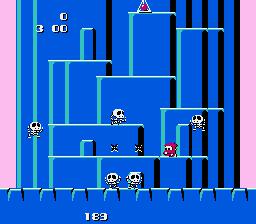
Ninja Taro
Nintendo Entertainment System · 1991
About this game
Ninja Taro is an action RPG set in feudal Japan with gameplay similar to "The Legend of Zelda".
In Japan, Ninja Taro is known as "Sengoku Ninja-kun", and is one of several titles in the Japanese "Ninja Jajamaru-kun" series.
↓ Read more
As the eponymous Ninja Taro (or "Ninja-kun" in the Japanese release), you are tasked by your teacher, Kashin-Koji, to seek out Lord Nobu ("Nobunaga Oda"), who has requested the service of the land's greatest ninja.
The path there is dangerous, but upon reaching Lord Nobu at Geko Castle, it is revealed that the evil Lord Shin Takeda ("Takeda Shingen") is rumored to have died.
You are tasked with investigating the rumors to see if they are true or not.
Lord Shin's castle is located in Kai Province, not too far from Geko Castle, but the direct path there is blocked by a "mighty beast", a creature who is said to be able to withstand all weapons.
Upon returning to your teacher for advice, you are tasked with seeking out your teacher's old friend, Kondo, in Iga Province.
However, Kondo is nowhere to be found, but instead Kondo's daughter, who you must convince to help you before you're able to continue on your quest...
Although you begin the game with your Ninja Sword and Throwing Stars, many other items can be found to assist you on your quest.
Additional weapons, the Masamune and the Throwing Knives, are not as strong as your primary weapons, but are more agile; medicinal Herbs and Potions may be found that can heal you; and unique tools such as Camouflage and Fire will also be at your disposal, among many others.
Ninja Taro pulls stylistically from many sources, including Japanese history as well as classical mythology.
Besides referencing real historical places and people, such as the real 16th century daimyo, Oda Nobunaga, Ninja Taro references many creatures from Japanese folklore, such as ghosts, tengu, and ogres.
Additionally, some elements of the game's design are decidedly more modern, with some monstrous adversaries and locales seemingly out
About Nintendo Entertainment System
The Nintendo Entertainment System (1983 in Japan, 1985 in the West) revived the North American video game industry after the 1983 crash and established conventions — cartridges, licensing seals, save systems — that shaped the industry for decades. NES collecting is one of the most established retro markets: common titles remain cheap, but a well-known handful of low-print-run games (many from smaller third-party publishers) are among the most expensive video games in existence.
Gamevaro tracks Ninja Taro for Nintendo Entertainment System with separate market values for loose, complete-in-box (CIB) and factory-sealed copies, sourced from real eBay sales. Prices also vary by region — PAL, NTSC-U and NTSC-J releases of the same game often sell for different amounts due to print run sizes and regional collector demand.
Adding Ninja Taro to a Gamevaro collection takes seconds — search by title or scan the box barcode, and the app fills in cover art, release details and current pricing automatically. This NES release dates back to 1991.
Market values by condition
No price data available yet.
Rarity & condition
No market sales have been tracked yet for Ninja Taro — this could mean it rarely changes hands, or simply that Gamevaro hasn't recorded a sale for it yet. Be the first to add it to your collection.
Condition matters a lot for collector value: loose (cartridge/disc only), complete-in-box (CIB, with original packaging and manual) and factory-sealed copies are tracked separately because the price gap between them can be significant, especially for older releases.
Frequently asked questions
How much is Ninja Taro worth?
Gamevaro hasn't tracked a market sale for Ninja Taro (Nintendo Entertainment System) yet, so no current value is available. Prices are sourced from real marketplace sales, and this page will update automatically once sales data comes in.
Is Ninja Taro rare?
No market sales have been tracked yet for Ninja Taro, which could mean it rarely changes hands or that Gamevaro simply hasn't recorded a sale for it yet.
What's the difference between loose, CIB and sealed for Ninja Taro?
Loose means cartridge or disc only, CIB (complete in box) includes the original box and manual, and sealed means factory-sealed and never opened. These are tracked as separate market values because the price gap between them can be significant, especially for older releases.
Ratings & Reviews
Also on other platforms
More Nintendo Entertainment System games