![3D Mahjongg [Casual Classics]](/covers/nintendo-3ds/134334.webp)
3D Mahjongg [Casual Classics]
Nintendo 3DS · 2013
About this game
3D MahJongg is a new take on the old game of Mahjong Solitaire (a.k.a.
It uses the same set of 144 tiles.
↓ Read more
The object of the game is simple; find two matching tiles that are not blocked by other tiles on either side (up and down is not an option), and slowly whittle away at the layout till all of the tiles have been removed.
While simple in practice, the possibilities are endless.
The game has two sets of rules, Rivers and Classic.
In Rivers, tiles must be on the same layer, and the line connecting them may not change direction more than twice.
In Classic, tiles must not be covered by other tiles, and must be free to their left or right side.
The game has two modes: Free Play and Adventure mode which has 200 combinations of the available options you must solve completely before moving forward.
There is no basic "save" feature, but rather you create a profile, and if you turn off the 3DS it will start you at the next level to be completed when you return to Adventure mode.
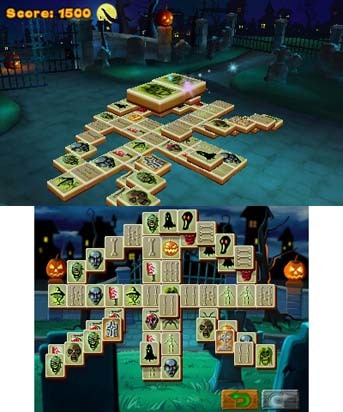
The layout is viewed on the touch screen and the 3D screen.
You chose your matching tiles (or the option to rewind or fast forward your moves) on the touch screen, and a 3D representation of the layout is seen on the upper screen.
The layouts are represented in 3D and with 50 different types, along with six different animated 3D backgrounds called "Scenes", as well as six different touch screen backgrounds, and six different tile sets which includes sea creatures, zombies, fantasy characters and traditional playing cards.
Like many puzzle games with multiple options, you have to unlock the additional layouts, scenes, backgrounds and tile sets, which is done through Adventure mode.
About Nintendo 3DS
The Nintendo 3DS (2011) added glasses-free stereoscopic 3D and a second analog input to Nintendo's handheld line, eventually building a library that rivaled the DS in size and quality. Because the eShop for digital purchases has since closed, physical 3DS cartridges are the only way to preserve access to many titles — a dynamic that's pushing more collectors toward cartridge-based copies even for games that were originally digital-first.
Gamevaro tracks 3D Mahjongg [Casual Classics] for Nintendo 3DS with separate market values for loose, complete-in-box (CIB) and factory-sealed copies, sourced from real eBay sales. Prices also vary by region — PAL, NTSC-U and NTSC-J releases of the same game often sell for different amounts due to print run sizes and regional collector demand.
Adding 3D Mahjongg [Casual Classics] to a Gamevaro collection takes seconds — search by title or scan the box barcode, and the app fills in cover art, release details and current pricing automatically. This 3DS release dates back to 2013.
Market values by condition
No price data available yet.
Rarity & condition
No market sales have been tracked yet for 3D Mahjongg [Casual Classics] — this could mean it rarely changes hands, or simply that Gamevaro hasn't recorded a sale for it yet. Be the first to add it to your collection.
Complete-in-box (CIB) copies typically command a premium over loose cartridges/discs because the original box and manual are more fragile and get discarded or damaged over time — fewer complete sets survive.
Frequently asked questions
How much is 3D Mahjongg [Casual Classics] worth?
Gamevaro hasn't tracked a market sale for 3D Mahjongg [Casual Classics] (Nintendo 3DS) yet, so no current value is available. Prices are sourced from real marketplace sales, and this page will update automatically once sales data comes in.
Is 3D Mahjongg [Casual Classics] rare?
No market sales have been tracked yet for 3D Mahjongg [Casual Classics], which could mean it rarely changes hands or that Gamevaro simply hasn't recorded a sale for it yet.
What's the difference between loose, CIB and sealed for 3D Mahjongg [Casual Classics]?
Loose means cartridge or disc only, CIB (complete in box) includes the original box and manual, and sealed means factory-sealed and never opened. These are tracked as separate market values because the price gap between them can be significant, especially for older releases.
Ratings & Reviews
Also on other platforms
More Nintendo 3DS games