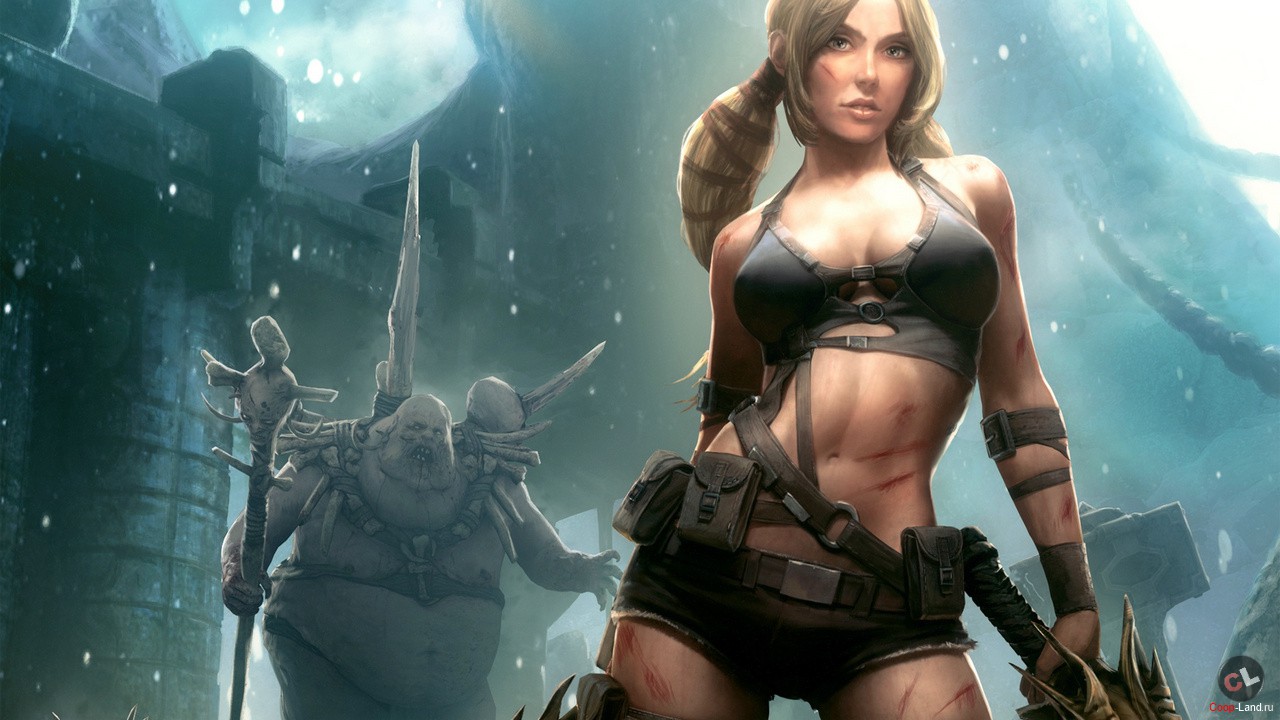
Blades of Time
Nintendo Switch · 2012
About this game
Blades of Time is the spiritual sequel to X-Blades by the same developer.
It again follows the story of Ayumi but does not pick up on the events of the previous game.
↓ Read more
She is a female treasure hunter who disrupts a rite of a guild to access a sphere that transports her to the fantasy world Dragonland.
She fights with a set of blades in over-the-top hack-and-slash gameplay reminiscent of the God of War series.
Slashes and kicks are linked into fast combos including finishing moves when an enemy has been forced into a submissive position.
She can also pick up a variety of long-ranged weapons such as rifles or a rocket launcher and these are also used to shoot objects that are out of reach to solve puzzles.
During her journey she can pick up diary pages from previous treasure hunters that explain how chaos magic has altered the environment and introduced monsters.
She also meets fellow treasure hunters along the way.
Ayumi regularly discovers altars where new skills are learned.
This includes for instance the ability to freeze enemies or rise giant ice crystals below them.
These can only be used when a rage bar is built up with up to three levels by defeating opponents.
She is also able to dash away to evade attacks or quickly close the distance towards an opponent.
In a menu Ayumi can equip the items and weapons she finds.
There are four slots: close combat, ranged attacks, amulets, and rings.
Previously found items are not dumped and it is possible to switch between items at any moment when a certain effect is needed such as additional fire damage.
Certain items can be crafted by discovering a recipe and collecting the necessary ingredients.
Time referenced in the title refers to the skill Ayumi eventually learns to rewind time and fight along with a clone of herself that performs the actions that were previously done.
This self-cooperative element is a way to confuse enemies carrying shield and is also vital to solve some of the puzzles in the later parts of the game
About Nintendo Switch
Released in 2017, the Nintendo Switch became one of the best-selling consoles of all time thanks to its hybrid handheld/docked design. Its cartridge-based physical format (as opposed to discs) has made complete-in-box collecting popular again, with certain limited print runs and Nintendo-published exclusives already commanding a premium on the secondhand market just a few years after release.
Gamevaro tracks Blades of Time for Nintendo Switch with separate market values for loose, complete-in-box (CIB) and factory-sealed copies, sourced from real eBay sales. Prices also vary by region — PAL, NTSC-U and NTSC-J releases of the same game often sell for different amounts due to print run sizes and regional collector demand.
Adding Blades of Time to a Gamevaro collection takes seconds — search by title or scan the box barcode, and the app fills in cover art, release details and current pricing automatically. This NSW release dates back to 2012.
Market values by condition
No price data available yet.
Rarity & condition
No market sales have been tracked yet for Blades of Time — this could mean it rarely changes hands, or simply that Gamevaro hasn't recorded a sale for it yet. Be the first to add it to your collection.
Complete-in-box (CIB) copies typically command a premium over loose cartridges/discs because the original box and manual are more fragile and get discarded or damaged over time — fewer complete sets survive.
Frequently asked questions
How much is Blades of Time worth?
Gamevaro hasn't tracked a market sale for Blades of Time (Nintendo Switch) yet, so no current value is available. Prices are sourced from real marketplace sales, and this page will update automatically once sales data comes in.
Is Blades of Time rare?
No market sales have been tracked yet for Blades of Time, which could mean it rarely changes hands or that Gamevaro simply hasn't recorded a sale for it yet.
What's the difference between loose, CIB and sealed for Blades of Time?
Loose means cartridge or disc only, CIB (complete in box) includes the original box and manual, and sealed means factory-sealed and never opened. These are tracked as separate market values because the price gap between them can be significant, especially for older releases.
Ratings & Reviews
Also on other platforms
More Nintendo Switch games
![Triangle Strategy [Tactician's Limited Edition] (NSW)](/covers/nintendo-switch/138553.webp)