Hue
Nintendo Switch · 2016
About this game
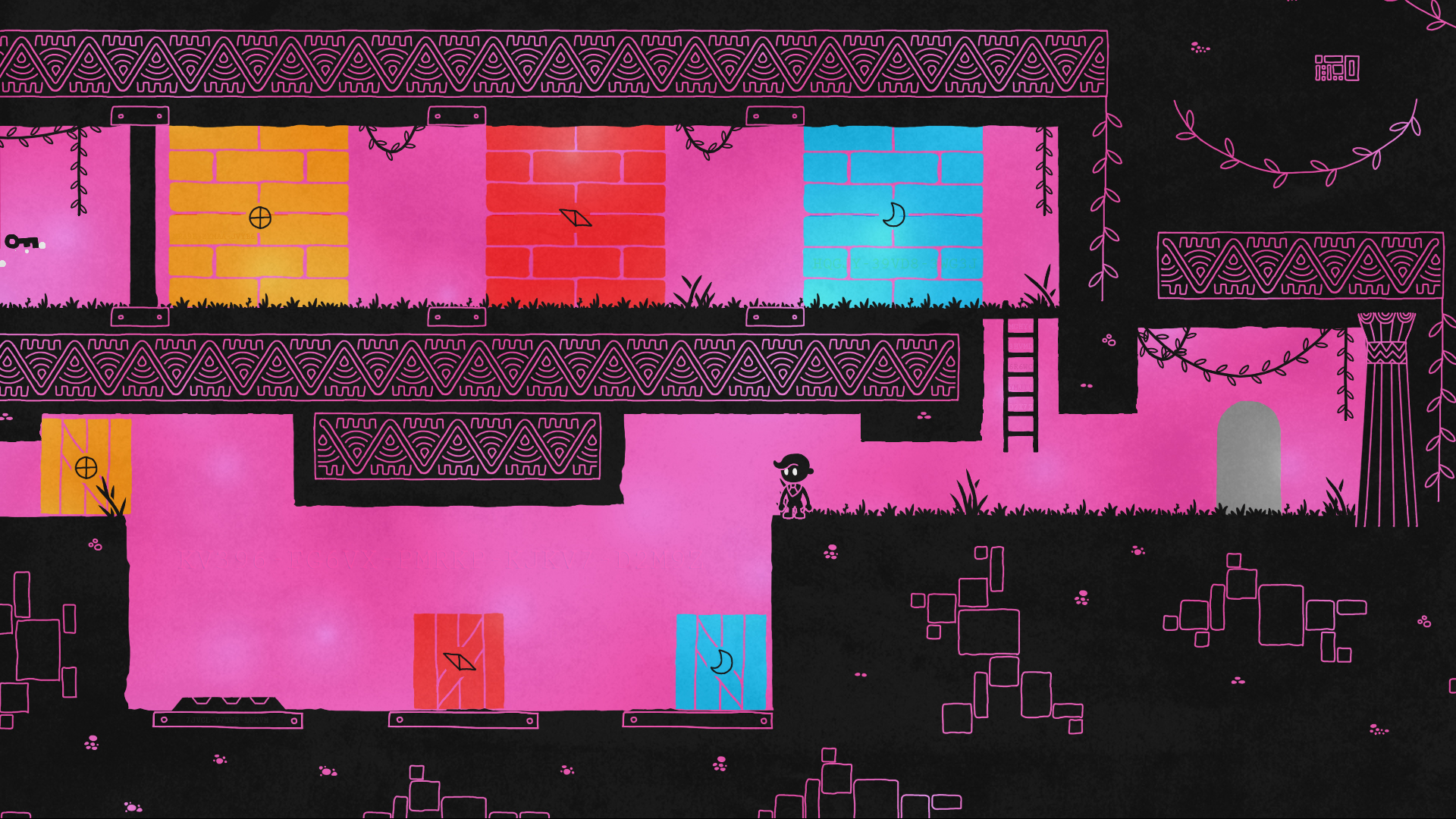
Hue is a puzzle game played as a side-scrolling platformer.
The player controls the male character Hue who needs to find back his missing mother.
↓ Read more
She developed a ring called Annular Spectrum which allows perception and alteration of impossible colours, beyond the human spectrum.
She was deceived by the traitorous professor Dr.
Grey she fell in love with and has now become invisible, as a shade of such as impossible colour.
It is up to Hue to restore the ring and bring her back by collecting the many scattered coloured shards.
The game consists of a large, 2D side-scrolling world where different environments are linked together through doors.
The game uses a silhouetted art style which is initially monochromatic.
Soon Hue discovers his first colour, which is added to a ring-like circle that can be summoned at any moment, as one of many bright colours.
Eventually eight colours can be collected: aqua, blue, lime, orange, pink, purple, red and yellow.
These are used for the main gameplay mechanic as the player can switch between them on the fly, even in the middle of actions as time is slowed down extensively during the selection.
Changing a colour brings it into the environment, colouring almost anything.
This mechanic is for instance used to discover hidden doors.
Obstacles, barriers and other elements often have a specific colour and when Hue switches colours to match it, it disappears into the environment as if it was never there.
The simple mechanic quickly becomes more complex due to moving elements, the ability to push and pull objects, platform-based puzzles, fast sequences and so on.
While Hue can jump and there are some general elements such as ladders or deadly spikes, almost every area needs to be approached as a puzzle that can be solved without time pressure.
With each new discovered colour puzzles become more complex.
There is also a minor metroidvania aspect to it as any area can be revisited, but mainly to open up passages leading to beakers as an optio
About Nintendo Switch
Released in 2017, the Nintendo Switch became one of the best-selling consoles of all time thanks to its hybrid handheld/docked design. Its cartridge-based physical format (as opposed to discs) has made complete-in-box collecting popular again, with certain limited print runs and Nintendo-published exclusives already commanding a premium on the secondhand market just a few years after release.
Gamevaro tracks Hue for Nintendo Switch with separate market values for loose, complete-in-box (CIB) and factory-sealed copies, sourced from real eBay sales. Prices also vary by region — PAL, NTSC-U and NTSC-J releases of the same game often sell for different amounts due to print run sizes and regional collector demand.
Adding Hue to a Gamevaro collection takes seconds — search by title or scan the box barcode, and the app fills in cover art, release details and current pricing automatically. This NSW release dates back to 2016.
Market values by condition
No price data available yet.
Rarity & condition
No market sales have been tracked yet for Hue — this could mean it rarely changes hands, or simply that Gamevaro hasn't recorded a sale for it yet. Be the first to add it to your collection.
Complete-in-box (CIB) copies typically command a premium over loose cartridges/discs because the original box and manual are more fragile and get discarded or damaged over time — fewer complete sets survive.
Frequently asked questions
How much is Hue worth?
Gamevaro hasn't tracked a market sale for Hue (Nintendo Switch) yet, so no current value is available. Prices are sourced from real marketplace sales, and this page will update automatically once sales data comes in.
Is Hue rare?
No market sales have been tracked yet for Hue, which could mean it rarely changes hands or that Gamevaro simply hasn't recorded a sale for it yet.
What's the difference between loose, CIB and sealed for Hue?
Loose means cartridge or disc only, CIB (complete in box) includes the original box and manual, and sealed means factory-sealed and never opened. These are tracked as separate market values because the price gap between them can be significant, especially for older releases.
Ratings & Reviews
Also on other platforms


More Nintendo Switch games
![Triangle Strategy [Tactician's Limited Edition] (NSW)](/covers/nintendo-switch/138553.webp)