Ms. Pac-Man
PC · 1981
About this game
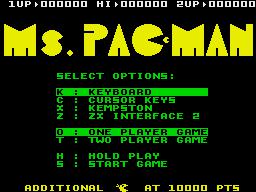
Pac-Man is a single-player maze-chase game.
Set in a series of interconnected neon mazes, the player guides Ms.
↓ Read more
Pac-Man as she eats dots and bonus fruit while being pursued by four ghosts.
A round ends when all dots are cleared, and a life is lost if any ghost touches Ms.
Play proceeds through a sequence of stages that rotate between distinct maze layouts, with brief comedic intermissions that show Ms.
Pac-Man’s relationship with Pac-Man and the appearance of Junior.
Core play centers on navigating corridors efficiently, managing risk around corners, and using the maze’s side tunnels to outmaneuver the pursuing ghosts.
Four large Energizers are positioned near the corners of each maze.
Eating an Energizer temporarily turns the ghosts blue, allowing Ms.
Pac-Man to eat them for points in a set progression of 200, 400, 800, and 1,600.
The blue-time shortens as stages advance, and later rounds reduce or remove the vulnerability window.
Compared to its predecessor, Pac-Man , Ms.
Pac-Man features four different maze designs that appear across the game’s stage order.
Maze geometry affects route planning, with changes in corridor width, dead-ends, and tunnel placement.
Side tunnels can alter ghost speed, and their placement varies by layout, so a safe escape on one maze might be unsafe on another.
Ghost behavior mixes pursuit and dispersal periods with movement that is less predictable than in the earlier game.
The four ghosts retain individual identities: Blinky, Pinky, Inky, and Sue, with Sue replacing Clyde.
Their paths can diverge based on player position, timing, and maze configuration, which encourages improvisation rather than relying on fixed patterns.
Bonus fruit differ from the earlier static items.
A single fruit enters mid-round from a side tunnel, moves along corridors, and exits if not collected.
Fruit types change as the game progresses and grant increasing point values.
Secondary options include alternating two-player mode, adjustable bonus-life
About PC
PC gaming spans over four decades, from early DOS titles to today's massive Steam and digital-storefront libraries. Because "PC" covers everything from 1990s CD-ROM releases to current AAA titles, it's the single largest platform by game count on Gamevaro. For collectors, PC gaming splits into two very different worlds: physical big-box releases from the 1990s and 2000s (increasingly collectible, especially complete-in-box with original manuals and inserts) and the modern digital library, which Gamevaro tracks for portfolio and spending purposes even though it has no resale market.
Gamevaro tracks Ms. Pac-Man for PC with separate market values for loose, complete-in-box (CIB) and factory-sealed copies, sourced from real eBay sales. Prices also vary by region — PAL, NTSC-U and NTSC-J releases of the same game often sell for different amounts due to print run sizes and regional collector demand.
Adding Ms. Pac-Man to a Gamevaro collection takes seconds — search by title or scan the box barcode, and the app fills in cover art, release details and current pricing automatically. This PC release dates back to 1981.
Market values by condition
No price data available yet.
Rarity & condition
No market sales have been tracked yet for Ms. Pac-Man — this could mean it rarely changes hands, or simply that Gamevaro hasn't recorded a sale for it yet. Be the first to add it to your collection.
Complete-in-box (CIB) copies typically command a premium over loose cartridges/discs because the original box and manual are more fragile and get discarded or damaged over time — fewer complete sets survive.
Frequently asked questions
How much is Ms. Pac-Man worth?
Gamevaro hasn't tracked a market sale for Ms. Pac-Man (PC) yet, so no current value is available. Prices are sourced from real marketplace sales, and this page will update automatically once sales data comes in.
Is Ms. Pac-Man rare?
No market sales have been tracked yet for Ms. Pac-Man, which could mean it rarely changes hands or that Gamevaro simply hasn't recorded a sale for it yet.
What's the difference between loose, CIB and sealed for Ms. Pac-Man?
Loose means cartridge or disc only, CIB (complete in box) includes the original box and manual, and sealed means factory-sealed and never opened. These are tracked as separate market values because the price gap between them can be significant, especially for older releases.
Ratings & Reviews
Also on other platforms
More PC games