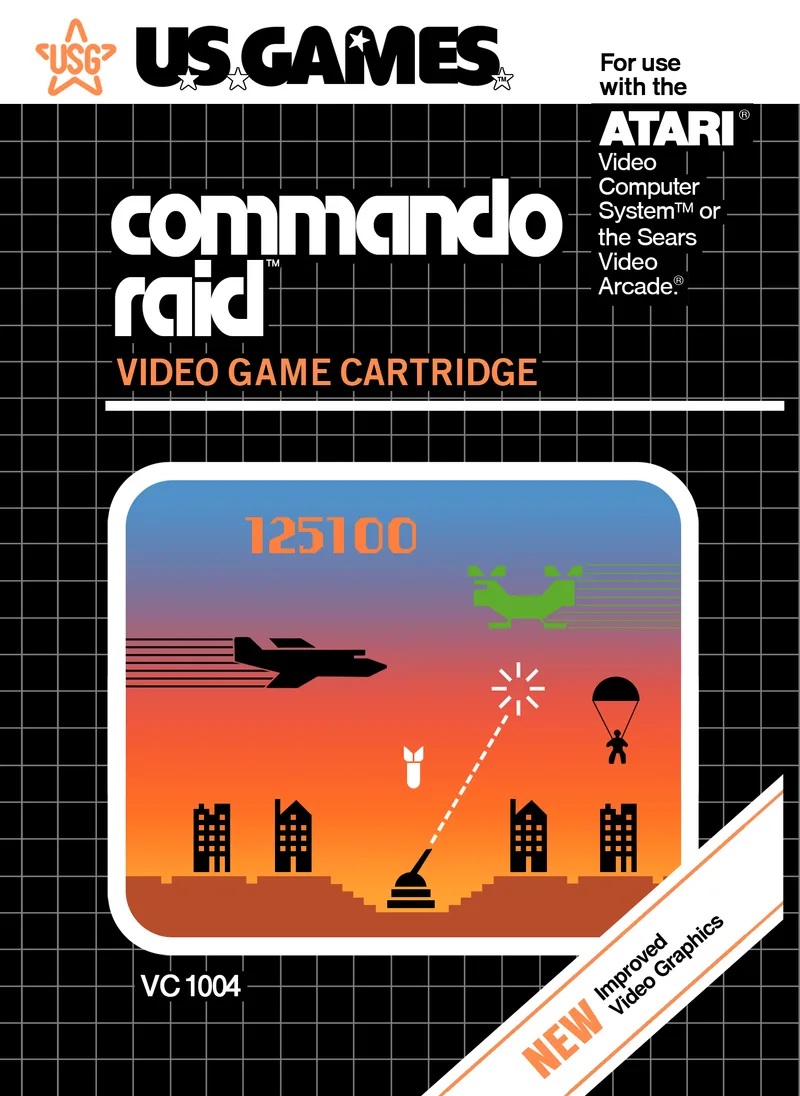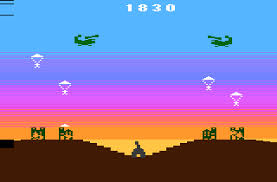
Commando Raid
Sega Saturn · 1982
About this game
In the near future, the military has created an advance computerized combat simulation, which allowed participants to be trained in various forms of combat throughout human history.
However, a programmer working for a corporation that seeks the downfall of the simulation developers infects the system with a virus.
↓ Read more
This virus creates a dimensional vortex that threatens to swallow the entire world.
Stanley Opar, a member of S.A.V.E (Special Action for Virus Elimination) enters the vortex with one goal: destroy the virus before the universe ceases to exist.
Time Commando is an action game with light puzzle-solving elements.
The player character travels to eight different time periods: Prehistoric, Roman Empire, Feudal Japan, Medieval, Conquistador, Wild West, Modern Wars, and Future.
Each era has its own characteristic enemies and sets of weapons: for example, Stanley fights with rocks and bone knives in the Prehistoric era, switching to shurikens and katanas in Japan, revolvers and shotguns in the Wild West, laser pistols in the future, etc.
Most of the time in the game is spent fighting enemies.
Character navigation and combat resemble those of Alone in the Dark .
The navigation is character- rather than camera-based, similarly to survival horror games.
During combat, Stanley has three attack moves at his disposal, as well as a blocking move.
Part of the challenge relies on choosing the right weapons against particular enemies.
Stanley starts with a small life bar that can be increased by picking up life power-ups, as well as multiple lives.
Time limit is imposed on each level.
To lower the countdown, the player has to deposit computer chips collected throughout the levels in special orb pools.
The game utilizes animated pre-rendered sequences to represent locations, and polygonal models for the characters.
About Sega Saturn
The Sega Saturn (1994/1995) struggled commercially against the PlayStation despite strong 2D capabilities and a library beloved by shoot-'em-up and RPG fans. Its relatively low sales translated directly into low print runs for many games, making the Saturn one of the more expensive retro platforms to collect completely — several titles now sell for hundreds of euros in good condition.
Gamevaro tracks Commando Raid for Sega Saturn with separate market values for loose, complete-in-box (CIB) and factory-sealed copies, sourced from real eBay sales. Prices also vary by region — PAL, NTSC-U and NTSC-J releases of the same game often sell for different amounts due to print run sizes and regional collector demand.
Adding Commando Raid to a Gamevaro collection takes seconds — search by title or scan the box barcode, and the app fills in cover art, release details and current pricing automatically. This SAT release dates back to 1982.
Market values by condition
No price data available yet.
Rarity & condition
No market sales have been tracked yet for Commando Raid — this could mean it rarely changes hands, or simply that Gamevaro hasn't recorded a sale for it yet. Be the first to add it to your collection.
Condition matters a lot for collector value: loose (cartridge/disc only), complete-in-box (CIB, with original packaging and manual) and factory-sealed copies are tracked separately because the price gap between them can be significant, especially for older releases.
Frequently asked questions
How much is Commando Raid worth?
Gamevaro hasn't tracked a market sale for Commando Raid (Sega Saturn) yet, so no current value is available. Prices are sourced from real marketplace sales, and this page will update automatically once sales data comes in.
Is Commando Raid rare?
No market sales have been tracked yet for Commando Raid, which could mean it rarely changes hands or that Gamevaro simply hasn't recorded a sale for it yet.
What's the difference between loose, CIB and sealed for Commando Raid?
Loose means cartridge or disc only, CIB (complete in box) includes the original box and manual, and sealed means factory-sealed and never opened. These are tracked as separate market values because the price gap between them can be significant, especially for older releases.