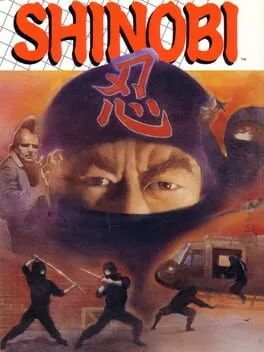
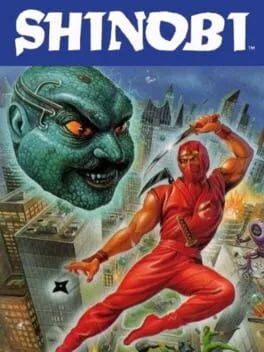
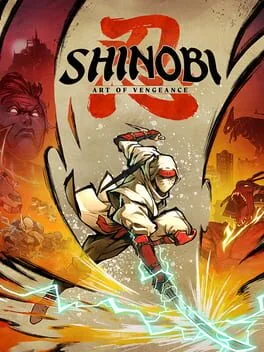
Shinobi
TurboGrafx-16 · 1987
About this game
The five missions in the game are each three or four stages long.
Several hostages are being held in each stage; Joe must rescue all of them before he is allowed to finish the stage.
↓ Read more
The last stage in each mission has no hostages, but instead features a powerful boss character whom Joe must defeat.
After completing each of the first four missions the player is taken to a bonus stage, where he can earn an extra life if he is able to kill all of the ninjas leaping towards him.
Completing the fifth mission ends the game.
Also, once the fifth mission begins, continues are no longer allowed; the player has to finish the game with however many lives he has left at that point.
If the player earns a place on the high score board, the number of credits it took him to get that score is displayed along with his score.
Joe's standard weapons are an unlimited supply of shuriken, along with punches and kicks when attacking at close range.
One hostage per stage gives him a power-up.
When powered-up, his throwing stars are replaced by a gun that fires large, explosive bullets, and his close-range attack becomes a katana slash.
Joe can also perform "ninja magic," which may be used only once per stage and kills (or damages, in the case of bosses) all enemies on the screen.
The game also allows the enemies to hide behind boxes or use shields to block Musashi's shurikens.[4]
Joe can be killed with one hit, provided he is hit by a projectile or melee attack, but if he does not find himself in those situations, the player can touch regular enemies and just be pushed back without being damaged.
Since most enemies appear in the same place on each level, it is possible to master the game by memorizing their locations and devising patterns to defeat them.
At the end of each stage, the player receives score bonuses based on performance.
Completing the stage without using ninja magic or without using any throwing stars or bullets earns the player a point bonus.
The player has three minutes to complete each stage; remaining time at the end of the stage is also converted to bonus points and added to the player's score.
About TurboGrafx-16
Known as the PC Engine in Japan, the TurboGrafx-16 (1989) punched well above its small form factor but never found a large audience in North America, leading to one of the smallest console libraries of its generation in the West. That limited Western release makes complete, boxed TurboGrafx-16 games some of the scarcer finds in retro console collecting today.
Gamevaro tracks Shinobi for TurboGrafx-16 with separate market values for loose, complete-in-box (CIB) and factory-sealed copies, sourced from real eBay sales. Prices also vary by region — PAL, NTSC-U and NTSC-J releases of the same game often sell for different amounts due to print run sizes and regional collector demand.
Adding Shinobi to a Gamevaro collection takes seconds — search by title or scan the box barcode, and the app fills in cover art, release details and current pricing automatically. This TG16 release dates back to 1987.
Market values by condition
NTSC-U
Recent sales
| Date | Type | Region | Price |
|---|---|---|---|
| 2026-07-20 | Loose / Item only | NTSC-U | €122.39 |
Rarity & condition
Only a handful of market sales have been tracked for Shinobi, suggesting it doesn't trade hands very often — a sign of relative scarcity compared to more common TurboGrafx-16 titles.
Complete-in-box (CIB) copies typically command a premium over loose cartridges/discs because the original box and manual are more fragile and get discarded or damaged over time — fewer complete sets survive.
Frequently asked questions
How much is Shinobi worth?
Shinobi for TurboGrafx-16 is currently worth €122.39 loose. Prices are based on real sales and update regularly on Gamevaro.
Is Shinobi rare?
Shinobi has only a handful of tracked market sales, suggesting relative scarcity compared to more common TurboGrafx-16 titles.
What's the difference between loose, CIB and sealed for Shinobi?
Loose means cartridge or disc only, CIB (complete in box) includes the original box and manual, and sealed means factory-sealed and never opened. These are tracked as separate market values because the price gap between them can be significant, especially for older releases.
Ratings & Reviews
Also on other platforms
More TurboGrafx-16 games