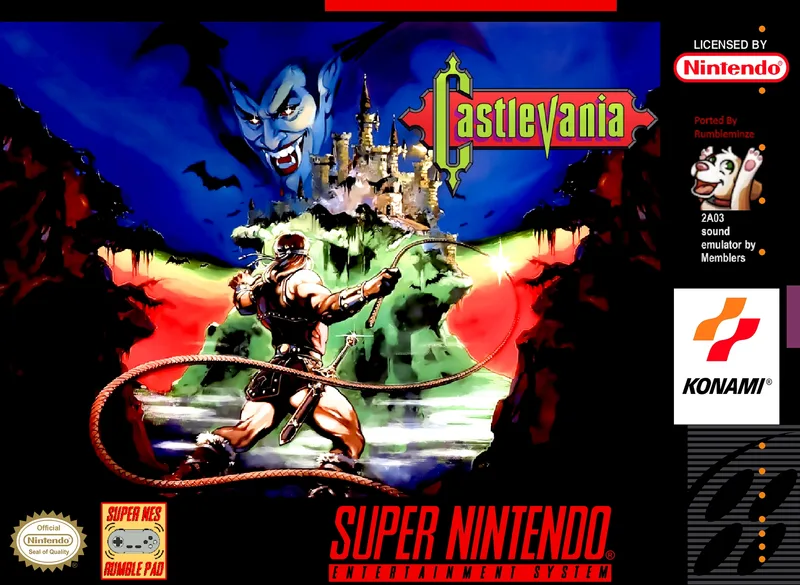
Castlevania
Nintendo Wii U · 1986
About this game
Castlevania is a single-player side-scrolling action platform game.
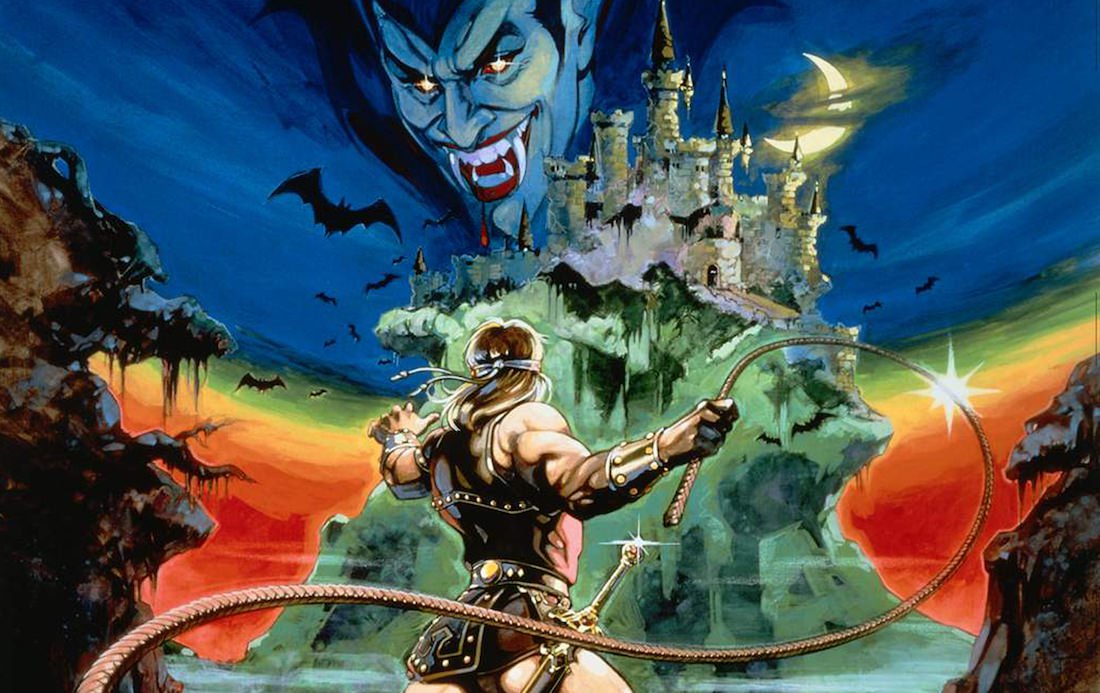
Every hundred years, Count Dracula returns to terrorize the land.
↓ Read more
Simon Belmont, heir to a famed line of vampire hunters, enters the Count’s sprawling castle to break the curse and end the rampage.
The fortress is a maze of halls, towers, catacombs, and clockworks filled with classic monsters and traps that guard the path to Dracula’s throne room.
Players guide Simon through a sequence of themed stages, each concluding with a boss encounter.
Movement emphasizes deliberate timing: jumps follow a fixed arc, stairs must be climbed to change vertical levels, and enemy hits cause knockback that can send Simon into pits or hazards.
A visible timer limits each stage, and losing all health, falling, or running out of time costs a life.
Checkpoints occur within stages, and limited continues allow progress to resume from the start of a section.
Simon’s primary weapon is the Vampire Killer whip, which strikes straight ahead.
Hitting certain candles and lanterns drops upgrades that extend the whip’s length and power.
Secondary “sub-weapons” expand combat options and consume hearts as ammunition.
These include the dagger, axe, holy water, stopwatch, and a returning boomerang-style cross.
Sub-weapons are switched by picking up a new one, encouraging players to choose tools that fit the next room’s enemies and layouts.
Resource and item management underpin the action.
Hearts, earned from candles and enemies, fuel sub-weapon use but do not restore health.
Roast meat hidden in breakable walls replenishes vitality.
Additional pickups provide temporary enhancements such as the Double Shot and Triple Shot, which let Simon throw multiple sub-weapons in quick succession, and invincibility or increased points.
Extra lives are awarded at score thresholds or by rare 1-Up items, while stage-specific hazards, such as moving platforms, collapsing bridges, and fire traps, test precision.
The game’s structure is linear, with a f
About Nintendo Wii U
The Wii U (2012) was commercially Nintendo's least successful home console, hampered by market confusion over whether the GamePad tablet controller was a new device or a Wii accessory. Its low sales mean smaller overall print runs across the board, and several first-party and indie darlings have already become noticeably pricier than their commercial performance would suggest, since there are simply fewer copies in circulation.
Gamevaro tracks Castlevania for Nintendo Wii U with separate market values for loose, complete-in-box (CIB) and factory-sealed copies, sourced from real eBay sales. Prices also vary by region — PAL, NTSC-U and NTSC-J releases of the same game often sell for different amounts due to print run sizes and regional collector demand.
Adding Castlevania to a Gamevaro collection takes seconds — search by title or scan the box barcode, and the app fills in cover art, release details and current pricing automatically. This WIU release dates back to 1986.
Market values by condition
No price data available yet.
Rarity & condition
No market sales have been tracked yet for Castlevania — this could mean it rarely changes hands, or simply that Gamevaro hasn't recorded a sale for it yet. Be the first to add it to your collection.
Condition matters a lot for collector value: loose (cartridge/disc only), complete-in-box (CIB, with original packaging and manual) and factory-sealed copies are tracked separately because the price gap between them can be significant, especially for older releases.
Frequently asked questions
How much is Castlevania worth?
Gamevaro hasn't tracked a market sale for Castlevania (Nintendo Wii U) yet, so no current value is available. Prices are sourced from real marketplace sales, and this page will update automatically once sales data comes in.
Is Castlevania rare?
No market sales have been tracked yet for Castlevania, which could mean it rarely changes hands or that Gamevaro simply hasn't recorded a sale for it yet.
What's the difference between loose, CIB and sealed for Castlevania?
Loose means cartridge or disc only, CIB (complete in box) includes the original box and manual, and sealed means factory-sealed and never opened. These are tracked as separate market values because the price gap between them can be significant, especially for older releases.
Ratings & Reviews
Also on other platforms
![Castlevania [5 Screw]](/covers/nes/89063.webp)
![Castlevania [Classic NES Series]](/covers/game-boy-advance/163293.webp)
![Castlevania [Promo Only - Not For Resale]](/covers/ps2/113065.webp)