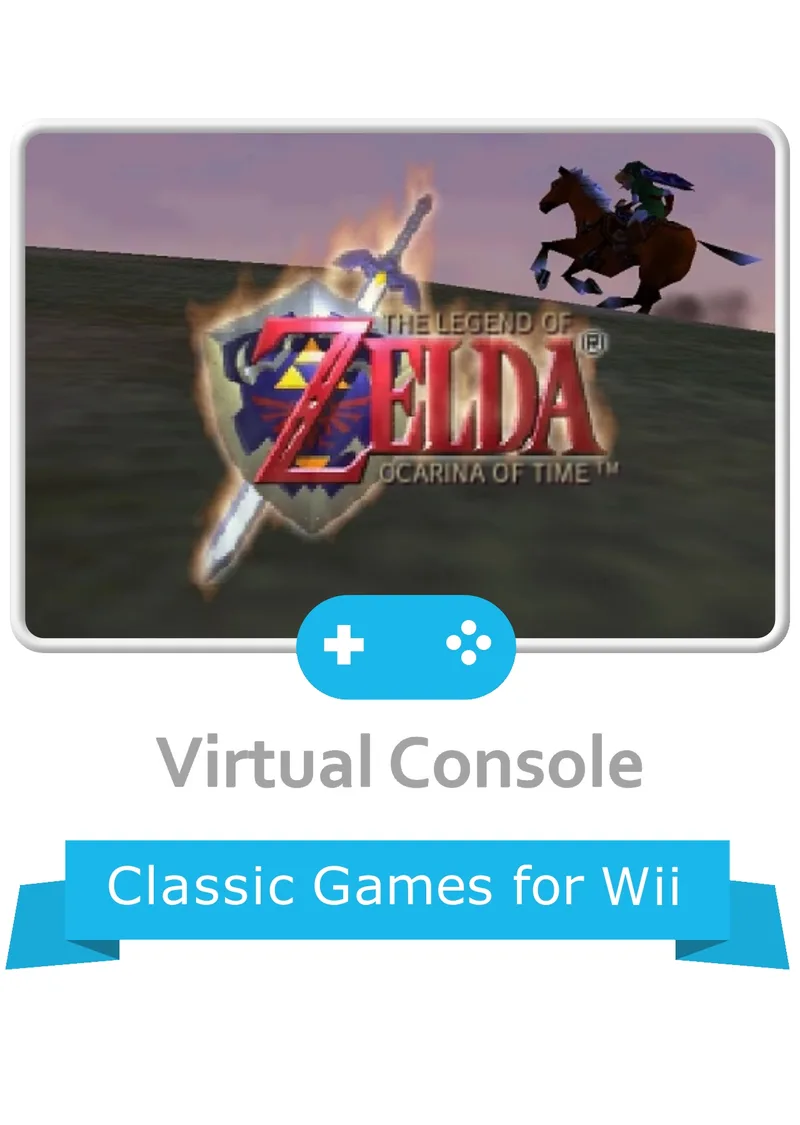
The Legend of Zelda: Ocarina of Time
Nintendo Wii · 2007
About this game
The Legend of Zelda: Ocarina of Time is a single-player action game with puzzle-solving elements.
The story follows Link, a boy raised among the Kokiri in the forest village of Hyrule.
↓ Read more
Summoned by the guardian spirit, the Great Deku Tree, Link learns of an impending danger: Ganondorf, leader of the Gerudo, seeks the Triforce, a sacred relic that grants godlike power.
With the aid of Princess Zelda and his fairy companion Navi, Link embarks on a quest to secure the three Spiritual Stones and open the path to the Sacred Realm before Ganondorf can seize control of Hyrule.
The adventure spans both Link’s childhood and adulthood, with time itself becoming central to his mission.
Gameplay is presented from a third-person perspective in a fully 3D environment, a first for the Legend of Zelda series .
Players guide Link across overworld fields, villages, rivers, and dungeons, each with its own enemies, puzzles, and bosses.
Combat mixes swordplay, shields, and ranged weapons, with a lock-on targeting system that allows precise movement and attacks.
Defeating enemies yields rupees, recovery hearts, or other items.
Exploration is closely tied to acquiring tools such as bombs, a slingshot, hookshot, and bow, which are often required to solve environmental puzzles and progress through dungeons.
Progression alternates between exploration of the open overworld and the completion of multi-room dungeons.
Each dungeon contains keys, maps, and compasses that aid navigation, as well as unique treasures that expand Link’s abilities.
Boss fights serve as climactic tests of newly acquired equipment, requiring observation and timing.
Collectible heart pieces hidden throughout the world gradually extend Link’s maximum health, while side quests often reward players with masks, upgraded gear, or expanded item capacity.
The Ocarina of Time itself is a core mechanic.
Link learns melodies that trigger in-game effects, such as changing the time of day, summoning rain, teleporting to specific loca
About Nintendo Wii
Launched in 2006, the Wii's motion controls (Wii Remote) brought casual and non-traditional players into console gaming at a scale no prior system had achieved, making it one of the best-selling consoles ever. Because so many Wii units sold with bundled software like Wii Sports, the bulk of the library is inexpensive to collect — but it also means truly rare Wii titles (often niche Japanese-only releases) stand out sharply from the norm.
Gamevaro tracks The Legend of Zelda: Ocarina of Time for Nintendo Wii with separate market values for loose, complete-in-box (CIB) and factory-sealed copies, sourced from real eBay sales. Prices also vary by region — PAL, NTSC-U and NTSC-J releases of the same game often sell for different amounts due to print run sizes and regional collector demand.
Adding The Legend of Zelda: Ocarina of Time to a Gamevaro collection takes seconds — search by title or scan the box barcode, and the app fills in cover art, release details and current pricing automatically. This WII release dates back to 2007.
Market values by condition
No price data available yet.
Rarity & condition
No market sales have been tracked yet for The Legend of Zelda: Ocarina of Time — this could mean it rarely changes hands, or simply that Gamevaro hasn't recorded a sale for it yet. Be the first to add it to your collection.
Condition matters a lot for collector value: loose (cartridge/disc only), complete-in-box (CIB, with original packaging and manual) and factory-sealed copies are tracked separately because the price gap between them can be significant, especially for older releases.
Frequently asked questions
How much is The Legend of Zelda: Ocarina of Time worth?
Gamevaro hasn't tracked a market sale for The Legend of Zelda: Ocarina of Time (Nintendo Wii) yet, so no current value is available. Prices are sourced from real marketplace sales, and this page will update automatically once sales data comes in.
Is The Legend of Zelda: Ocarina of Time rare?
No market sales have been tracked yet for The Legend of Zelda: Ocarina of Time, which could mean it rarely changes hands or that Gamevaro simply hasn't recorded a sale for it yet.
What's the difference between loose, CIB and sealed for The Legend of Zelda: Ocarina of Time?
Loose means cartridge or disc only, CIB (complete in box) includes the original box and manual, and sealed means factory-sealed and never opened. These are tracked as separate market values because the price gap between them can be significant, especially for older releases.
Ratings & Reviews
Also on other platforms
![The Legend of Zelda: Ocarina of Time [Collector's Edition]](/covers/n64/97462.webp)
![The Legend of Zelda: Ocarina of Time [Player's Choice]](/covers/n64/97499.webp)
![The Legend of Zelda: Ocarina of Time [Not For Resale]](/covers/n64/97516.webp)
More Nintendo Wii games