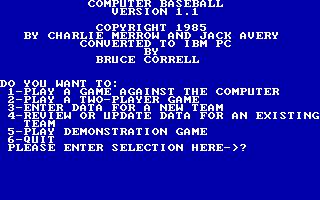
Computer Baseball
Commodore Amiga · 1981
About this game
Two otherworldly and all-powerful demons are competing with two unwitting human champions over the future of the magical realm of Xanth.
One of these unlikely champions is Dug Mundane, a young lad from our world who has just broken up with his girlfriend Pia.
↓ Read more
His friend Edsel sends him a computer game, betting that if Dug ends up liking it he'll forfeit his attempts to win Pia's heart back.
However, when Dug puts the game disk into his computer, he is teleported to Xanth, where his adventures begin.
Companions of Xanth is an adaptation of Piers Anthony 's fantasy novel Demons Don't Dream (included in some releases), taking place in his mystical and punny world of Xanth.
Unlike Legend 's previous parser-based adventures, this one is fully mouse-controlled.
Commands such as "take", "give to", "listen", etc. are on the left of the screen; directional icons and an inventory are at the bottom, with an illustration of the current location taking up over half of the screen.
The gameplay relies mostly on inventory-based puzzles, with many solutions involving puns.
Besides puzzle-solving, there are also branching conversations with the various characters populating the world.
The game is divided into several areas; some are interconnected, while others become unavailable for exploration as the plot advances.
It is possible to die in the game, though the player is allowed to undo his last move if that happens.
There are also a few instances of getting irrevocably stuck if the player failed to pick up a crucial item in an earlier area.
Although the game invites the player to pick up a companion in the beginning, only one choice is correct, while others lead to a premature end of the game.
The chosen companion can be talked to most of the time and provides hints and solutions to some puzzles.
About Commodore Amiga
The Commodore Amiga (1985) was ahead of its time technically — multitasking, custom graphics and sound chips — and built a passionate following in Europe in particular, where it rivaled and often outsold contemporary consoles. Amiga collecting today is a niche but dedicated hobby: original boxed software on floppy disk is comparatively scarce since floppies degrade, making well-preserved complete copies genuinely valuable to the right collector.
Gamevaro tracks Computer Baseball for Commodore Amiga with separate market values for loose, complete-in-box (CIB) and factory-sealed copies, sourced from real eBay sales. Prices also vary by region — PAL, NTSC-U and NTSC-J releases of the same game often sell for different amounts due to print run sizes and regional collector demand.
Adding Computer Baseball to a Gamevaro collection takes seconds — search by title or scan the box barcode, and the app fills in cover art, release details and current pricing automatically. This AMIGA release dates back to 1981.
Market values by condition
PAL
Recent sales
| Date | Type | Region | Price |
|---|---|---|---|
| 2026-07-17 | Loose / Item only | PAL | €9.87 |
Rarity & condition
Only a handful of market sales have been tracked for Computer Baseball, suggesting it doesn't trade hands very often — a sign of relative scarcity compared to more common Commodore Amiga titles.
Complete-in-box (CIB) copies typically command a premium over loose cartridges/discs because the original box and manual are more fragile and get discarded or damaged over time — fewer complete sets survive.
Frequently asked questions
How much is Computer Baseball worth?
Computer Baseball for Commodore Amiga is currently worth €9.87 loose. Prices are based on real sales and update regularly on Gamevaro.
Is Computer Baseball rare?
Computer Baseball has only a handful of tracked market sales, suggesting relative scarcity compared to more common Commodore Amiga titles.
What's the difference between loose, CIB and sealed for Computer Baseball?
Loose means cartridge or disc only, CIB (complete in box) includes the original box and manual, and sealed means factory-sealed and never opened. These are tracked as separate market values because the price gap between them can be significant, especially for older releases.
Ratings & Reviews
More Commodore Amiga games


![Populous II: Trials of the Olympian Gods [Plus Edition] (AMIGA)](/covers/commodore-amiga/161613.webp)