Push Over
Commodore Amiga · 1992
About this game
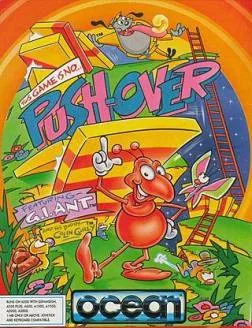
You're playing a small ant that is willing to help a friend in a rather inconvenient situation.
Apparently, the Quavers mascot Colin Curly likes his Quavers so much he lost balance and dropped them down a giant ant-hill.
↓ Read more
It's now your job to go in, in a mission to solve puzzles and retrieve the snacks for your friend.
Now, this ant-hill is a bit different from the ones you saw, and especially from the one you live in.
Its path is filled with domino-like tiles and closed gates that must get through to find the snacks.
You'll have to traverse different themed worlds in order to retrieve Colin's precious Quavers.
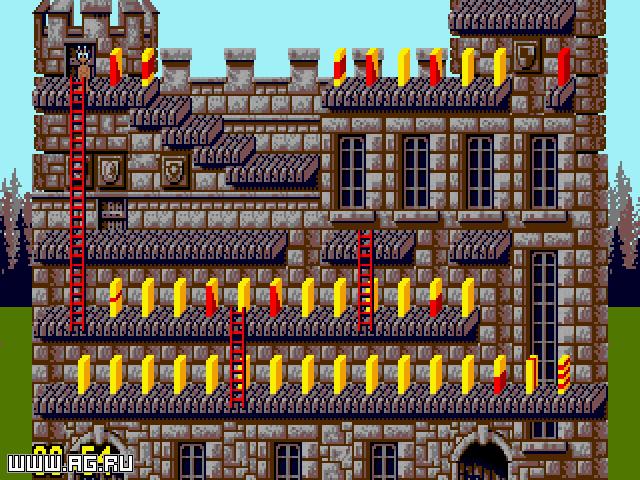
The main game consists in controlling the ant from a standard third-person platformer perspective and moving dominoes to place them in a well imagined line, so that when you push the correct one, all of them fall with a specifically marked tile falling last.
The door will otherwise stay shut and you will be unable to progress.
In addition to that, your ant can't fall from too high or it will die and make you restart the level.
Every domino tile has its own marking.
For example, yellow ones are the ones you simply push in a direction so they push the one next to them, most often in a chain reaction.
Red ones, on the contrary, can't be pushed at all (but can be moved) and tiles that hit it will fall back in the opposite direction.
Other types of tiles include one that explodes when being pushed or hit by another tile, clearing the way for other tiles; one that keeps moving ahead until it hits another tile; one that creates a bridge over a gap; or one that moves straight up and stick to the ceiling, pushing a tile next to it.
Each level is timed and requires quick thinking in order to be completed successfully.
Upon completion of a level, the player is given a password that can be used to resume the game at the level they last left off.
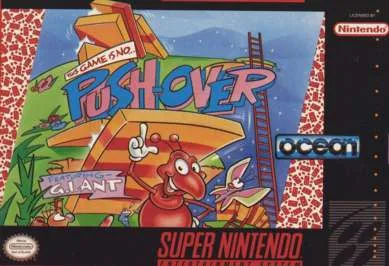
The SNES version doesn't have the Quavers branding and involves retrieving drops of cash for a rat character instead.
About Commodore Amiga
The Commodore Amiga (1985) was ahead of its time technically — multitasking, custom graphics and sound chips — and built a passionate following in Europe in particular, where it rivaled and often outsold contemporary consoles. Amiga collecting today is a niche but dedicated hobby: original boxed software on floppy disk is comparatively scarce since floppies degrade, making well-preserved complete copies genuinely valuable to the right collector.
Gamevaro tracks Push Over for Commodore Amiga with separate market values for loose, complete-in-box (CIB) and factory-sealed copies, sourced from real eBay sales. Prices also vary by region — PAL, NTSC-U and NTSC-J releases of the same game often sell for different amounts due to print run sizes and regional collector demand.
Adding Push Over to a Gamevaro collection takes seconds — search by title or scan the box barcode, and the app fills in cover art, release details and current pricing automatically. This AMIGA release dates back to 1992.
Market values by condition
PAL
Recent sales
| Date | Type | Region | Price |
|---|---|---|---|
| 2026-07-16 | Loose / Item only | PAL | €30.56 |
Rarity & condition
Only a handful of market sales have been tracked for Push Over, suggesting it doesn't trade hands very often — a sign of relative scarcity compared to more common Commodore Amiga titles.
Complete-in-box (CIB) copies typically command a premium over loose cartridges/discs because the original box and manual are more fragile and get discarded or damaged over time — fewer complete sets survive.
Frequently asked questions
How much is Push Over worth?
Push Over for Commodore Amiga is currently worth €30.56 loose. Prices are based on real sales and update regularly on Gamevaro.
Is Push Over rare?
Push Over has only a handful of tracked market sales, suggesting relative scarcity compared to more common Commodore Amiga titles.
What's the difference between loose, CIB and sealed for Push Over?
Loose means cartridge or disc only, CIB (complete in box) includes the original box and manual, and sealed means factory-sealed and never opened. These are tracked as separate market values because the price gap between them can be significant, especially for older releases.
Ratings & Reviews
Also on other platforms


More Commodore Amiga games